By the time a toddler ran on the pitch, the malaise plaguing the team had fully set in. Another alarming performance raised more questions about whether this team is fully lost.
Both parties, players and manager alike, stand at a crossroads with an entire season unraveling.
Not a single decision went right for either the manager or the players. In fact, their performance felt like a collective surrender for the season.
When the MLS season returned last month, and the slide from May continued, fans hoped that another brief break from play would give the Quakes a needed reset. Instead, their performances since the end of the Leagues Cup seem to be even worse than before. As Saturday’s embarrassment showed, doubts are starting to creep in about whether the locker room is lost.
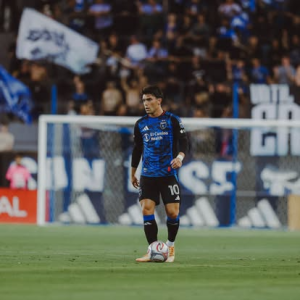
 Credit: San Jose Earthquakes
The last time the Quakes kept a clean sheet was back in April against an SDFC that was slowly figuring things out. Since then, teams figured out how to pull apart a backline that just soaks up pressure. Despite being an All-Star this season, the team’s over-reliance on Munie to be their stopper is starting to cost them dearly.
By May, Arena’s team found themselves challenging for the Supporters’ Shield with the playoffs seemingly in the bag.
Now with just about two months left, that elusive first playoff game at PayPal Park may be a long shot.
Around the 75th minute, Kyndra de St. Aubin noted that Preston Judd had stopped running and seemed checked out. Not wanting to completely throw the player under the bus, she joked that the gear he was wearing would show the training staff it.
Having a player’s commitment questioned during a game is one of the more embarrassing things that can happen to any professional. Not only does it reflect poorly on the player, but it also signals a much deeper issue within the team. While Judd eventually picked up his play when it seemed that Jovanovic was about to be subbed on, that one remark encapsulates the current state of the Quakes.
Having been one of the best stories during this revival, and rewarded with a new contract, Judd reverted to a shell of himself. Michael Boxall pushing him around with no issue showed just how much his stock has fallen. For a player who uses his physicality to create chances, getting shoved off the ball hints at a regression.
Placing all the personnel issues on Judd would be unfair to the player and team. Plenty of other players showed little fight in that disaster class.
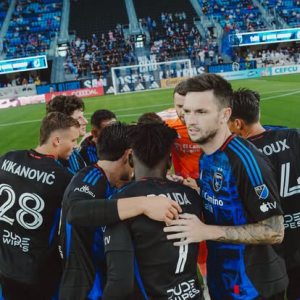
 Credit: San Jose Earthquakes
After remaining rather consistent, Beau Leroux disappointed by not tracking back, leaving Jonathan González and then Harkes to cover for him. The left side of the pitch barely tried to help, only caring about countering. To not discuss the horrific Angus Gunn performance would be wrong, as the Scottish keeper remains a terrible bit of business.
Amidst Saturday’s carnage, a few players could leave proud of their effort, if not the quality of it. Through the end of the game, Ousseni Bouda tried his best to find that killer pass that would give the Quakes a chance. Munie and Tsakiris, both a bit hamstrung by the various schemes, still tried to keep any chance alive.
Judd’s performance raised doubts over his effort in a drubbing, but the rest of the team didn’t cover itself in glory.
Physical and technical struggles can be explained, but a lack of effort is inexcusable.
While they still sometimes struggle offensively, Arena’s attack still finds itself around the top of the West. Focusing on the defensive issues feels like overkill, but the regression has completely cost the team.
As mentioned during his post-game press conference, Arena said that changes are on the way. Among all the possible moves to be made, everything must start with changing Munie’s role.
Used almost as a defensive mid, Munie chases around the opponent’s main threat, often deep into the midfield. Fortunately, the All-Star’s defensive prowess makes this role a possibility. While this role lets him win the ball back higher up the pitch and build a good counter, it leaves the old enemy: open space.
Almost every goal comes from the team losing the ball, forcing Munie off his line and into the midfield to chase. Behind him, opponents run rampant without any real pressure, often worsened by players not tracking back. The issue isn’t that the defensive structure collapses, but that the structure itself allows for opponents to run wild.
 Credit: MLS
While changing keepers could help the backline leak fewer goals, keeping Munie in this role will only create more chances for opponents. The only option to keep this system in place is to change the formation. Moving to a 4-3-3 with a defensive midfielder gives Munie cover when he makes these runs.
However, any sort of move of this magnitude would have impacts on the rest of the roster that may be beneficial. Tsakiris, already impactful when drifting out wide, would replace Bouda on the right wing to essentially mirror the Werner role. Additionally, a move like this opens up room for another midfielder next to Leroux that would make his life easier.
When they dominated the Western Conference earlier in the year, the success came through a tight defense.
Teams finally understood how to break down the Quakes, and without any change, they risk seeing everything come apart.
From off-field theatrics, the baby running on the pitch and a fan throwing beer at Arena, to the on-field disaster, something feels pivotal about the game against Minnesota. In the span of ninety minutes, every frustration manifested itself on the pitch.
With teams starting to catch fire below them, they have no room left for error.